


Ready to build your AI-native delivery capability?
Contact Equal Experts to explore how our product delivery and AI experience can support your next phase of growth.



Enterprises are struggling to keep up to speed with what’s possible with AI in product delivery. Some of today’s leading practices even look “ordinary” surprisingly quick, but we know from decades of experience how to tell what’s durable and what’s not.
What we bring is deep experience of building and improving complex digital products, growing hands-on AI capability, and the judgement to work out what makes sense in your environment. We experiment with you, measure what changes, and scale what proves valuable.
Our test: if you remove the AI, would you have to rebuild how the team works? If yes, that’s AI-native. If the team could carry on unchanged, it’s AI-assisted: useful, but not transformative.
AI-native: A four-person engineering team defines a permissions feature, then a coding harness runs parallel agents for backend, frontend, tests, migrations, and docs. Humans mainly steer and review.
But, if you remove AI, the workflow breaks because there are more active workstreams than humans available to execute them. And the humans cannot simply start working directly with machine-readable context and guardrails designed for agents.
AI-assisted: The same four engineers each own part of the permissions feature and use AI to write boilerplate, debug, or generate tests faster. Remove AI, and they keep doing the same jobs and workflow – just more slowly. This was not AI-native.
At the centre of this shift is shared context: the same agents, context and working environment available to an entire team, rather than a patchwork of individual copilots. That’s what lets teams move from humans executing with AI assistance to humans setting intent and judgement while agents handle bounded execution and coordination.
In practice, this looks like smaller (or differently-shaped) teams, work coordinated through context instead of tickets and handoffs, and human effort shifting from doing the work to directing it.

Faster idea-to-production time, faster research, design and test cycles, less repetitive execution work, more alternatives explored for the same effort.
More delivery capacity without adding headcount, faster strategy-to-hypothesis cycles, less coordination overhead, human effort shifting from execution to judgement.
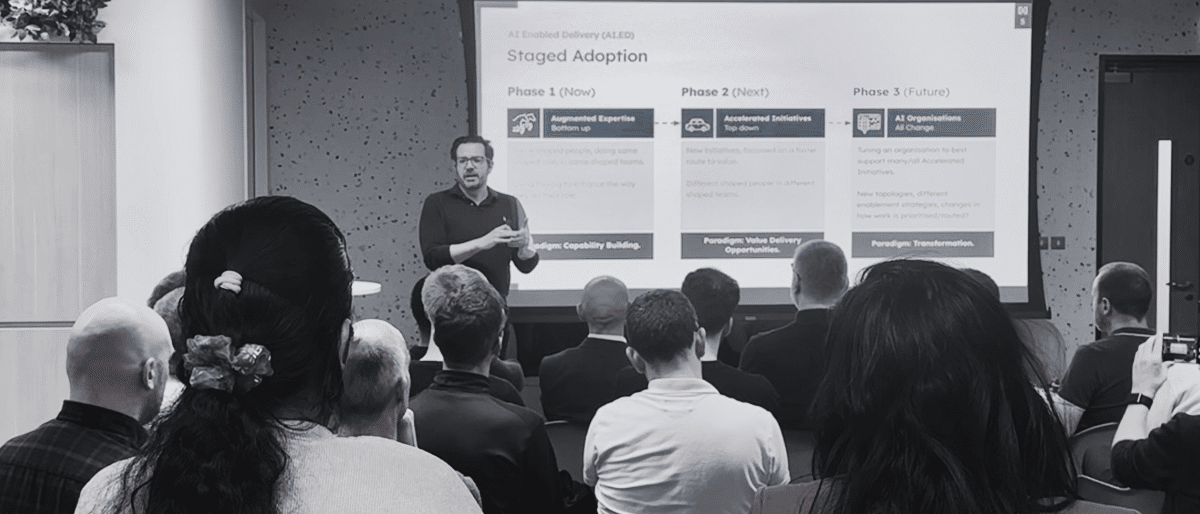
Faster time to market and to learning, better customer outcomes, lower cost of delay, cheaper experimentation, earlier abandonment of weak ideas.

Understand: Investigate where AI could genuinely change delivery, where is AI-assisted enough, where are the real bottlenecks and risks.

Experiment: Take one team, one workflow, one feature path. Establish a baseline, test the hypothesis with real work, and measure what actually changes.

Productionise: When an experiment proves its worth, we build the delivery system that makes it dependable. This is harness engineering: designing the working environment around the whole process. Delivering a single feature usually involves several agents planning, building, reviewing and testing together. The harness is what holds them together: the shared context they draw on, the tools and services they can reach, the memory they carry between steps, the evaluations and guardrails that keep them on track, and the telemetry that shows what they did and what it cost. We help you decide what to buy, what to configure and what to build, so you come away with the right delivery system rather than unnecessary technology.

Platformise and scale: Once a way of working has proven itself in one team, it is worth making repeatable. We turn what worked into shared paved roads: common context, shared evaluation, and the controls and governance encoded once so every team inherits them, with local ownership of the workflows on top. Building your AI platform this way, out of practice that has already earned its place, avoids the more common and more costly mistake of building the platform first and hoping teams adopt it.
Uplift: You should come out of working with us more capable: embedded practitioners, coaching, playbooks, patterns.

The goal isn’t less governance, but governance capable of supporting agentic delivery without turning every agent action back into a human queue.
In practice, that means turning gatekeepers into guardrails: evals and deterministic checks built into every stage of the loop rather than checked at the end, human-in-the-loop calibrated to how risky a given step actually is, and not every issue stopping the whole process. Agent identity, access, and actions run through proper control planes, with observability and graceful recovery built in as first-class parts of the system.
Contact Equal Experts to explore how our product delivery and AI experience can support your next phase of growth.
AI-Native Product Delivery means that AI has changed how product work actually gets done, not just how fast individuals work. Equal Experts tests this simply with one question: if AI was removed from a team’s workflow, would the team have to rebuild how it works? If yes, it’s AI-native. If the team could carry on unchanged, it’s AI-assisted.
An AI-assisted team uses AI to work faster inside the same roles and workflow. If AI were removed, the team could carry on as before, just more slowly. An AI-native team, on the other hand, has reshaped its work around AI, so removing it forces a rebuild.
Equal Experts describe the need for smaller teams. Think closer to a four-person engineering team than ten. They define features, then run parallel AI agents through a coding harness while humans mainly steer and review. Work is coordinated through shared context instead of tickets and handoffs. People set intent and judgement, and agents handle bounded execution and coordination.
Equal Experts uses five stages. Understand where AI could genuinely change delivery. Experiment with one team, one workflow and one feature path, measuring what changes. Productionise through harness engineering. Platformise and scale what has proven valuable. Uplift your people with embedded practitioners, coaching and playbooks.
Equal Experts builds governance as guardrails, not gates. Evals and deterministic checks run at every stage rather than at the end, and human oversight matches how risky each step is. Agent identity, access and actions run through proper control planes, with observability and graceful recovery built in.
Equal Experts report measurable results and impact with their clients. At the Department for Environment Food and Rural Affairs, AI cut the time to complete and synthesise user research by 56%, and 5 senior experts replaced a forecast team of 8. At Travelopia, 3 engineers replaced a lead scoring system for three regions in 3 months. At PX, 2 consultants shipped a production system in 6 weeks.