

Want to know more?
Are you interested in this project? Or do you have one just like it? Get in touch. We’d love to tell you more about it.


How do you modernise a national passport application system used by millions of British nationals all over the world?
His Majesty’s Passport Office (HMPO) wanted to replace its paper-based system that required full manual processing of applications and inflexible workflow processes, to transform the UK’s passport application process. Becoming digital by default would enable the processing of applications to be as efficient as possible, while making applying for a passport as quick and simple as it could be for its customers.
Equal Experts worked with HMPO to build a digital platform – Digital Application Processing (DAP) – that has delivered a consistent and reliable service that is now 100% digital.
The transformation has established HMPO as a world leader in digital government services and demonstrates our ability to deliver complex, critical digital services in highly regulated environments through agile, user-centred design.

digital processing
digital applications handled to date
working days per year saved
HMPO stands for His Majesty’s Passport Office, a government agency responsible for issuing passports to British citizens and overseeing civil registration services in England and Wales. Operating under the Home Office, HMPO manages passport applications and the registration of births, deaths, and marriages. The organisation employs over 4,000 staff across eight regional offices and processes more than seven million passport applications each year.




UK passport application processes were largely paper based, requiring people to submit documents like original birth certificates to one of HMPO’s regional offices. This required labour-intensive manual processing, and moving large amounts of paper around offices.
The rigidity of HMPO’s legacy Application Management System (AMS) made it hard for the organisation to make changes or respond to sudden increases in demand. Passport application systems were outsourced, leaving HMPO with limited control over these systems. Teams also lacked Agile delivery digital skills. Operational users faced long lead times for any changes, and felt they had little input into how to improve their ways of working.
To add to the challenge at the time, Brexit and the Covid pandemic led to teams dealing with significant changes, huge surges in demand, and the adaptation to remote working.
The goal of this transformation was to speed up turnaround times for processing passport applications to get passports in the hands of customers sooner, as well as to improve job satisfaction for passport examiners. To do this, we needed to safely increase automation to reduce the burden on the workforce, replacing paper applications and documents with digital equivalents where possible.
Equal Experts worked alongside HMPO teams to deliver a product-led, Agile approach to designing and building a digital application processing service (DAP). We worked in phases, in co-sourced, cross-functional teams that included Equal Experts consultants, HMPO civil servants, and other suppliers.
We wanted to have complete confidence in the solution we would eventually roll out, so we began – in partnership with Government Digital Service (GDS) – by building an end-to-end journey to print a single passport.
This allowed us to address some significant challenges early on – like establishing good cross-team collaboration and communication with multiple teams working on different elements of the journey. While this meant several months without new public releases, it provided a foundation for faster rollouts in future.
Next, we built and scaled common application types, and set up a Solution Delivery Centre, where developers and passport examiners could work together to spot inefficiencies and pain points. This collaboration helped us to understand what was possible and how the organisation could adapt to the new system while application volumes were still manageable (up to about 2 million annually).
We designed and built DAP while still running the legacy AMS platform in parallel, gradually transferring functionality and applications to DAP as users gained confidence in the new platform. DAP started processing live applications in January 2018; today it processes 100% of all UK passport applications. The service is so efficient that some users report submitting an application on Monday and receiving a passport by Friday.
Agile delivery approach: With clear paths to production and automated CI/CD pipelines, teams were able to release code 5-15 times each day, to respond more quickly to evolving needs and changes in demand. We also worked with HMPO’s central change/release functions to devise new, streamlined change control agreements to support risk free continuous delivery.
User-centred design: We created a Digital Design Suite (DDS), which acted as a model office where passport examiners could process real applications in a secure environment alongside our delivery team. This enabled fast feedback loops and invaluable user observation, ensuring that the user interface met the needs of examiners while also complying with government service standards. This user-centred design approach boosted confidence and reduced the need for ongoing training.
You Build It, You Run It: The teams responsible for building DAP were also (and still are) responsible for live service operations. This includes support, incident response, and developing product for the Home Office Service Desk to ensure knowledge is embedded and issues are resolved quickly. This approach ensures a focus on sustainability and resilience.
Resilience and scalability: Building in resilience was essential. Key features of DAP include:
A culture of learning: One of our underlying objectives throughout the transformation was to bring knowledge and IP back into government, by building the HMPO team’s internal delivery capability and experience.
We delivered this by working collaboratively alongside civil servants at every level, upskilling them through Equal Experts’ commitment to ‘learning-by-doing’. As well as engineers and senior leaders, our consultants also worked closely with other suppliers, establishing a ‘one team’ approach that focused on shared responsibility for outcomes in a low-ego environment.

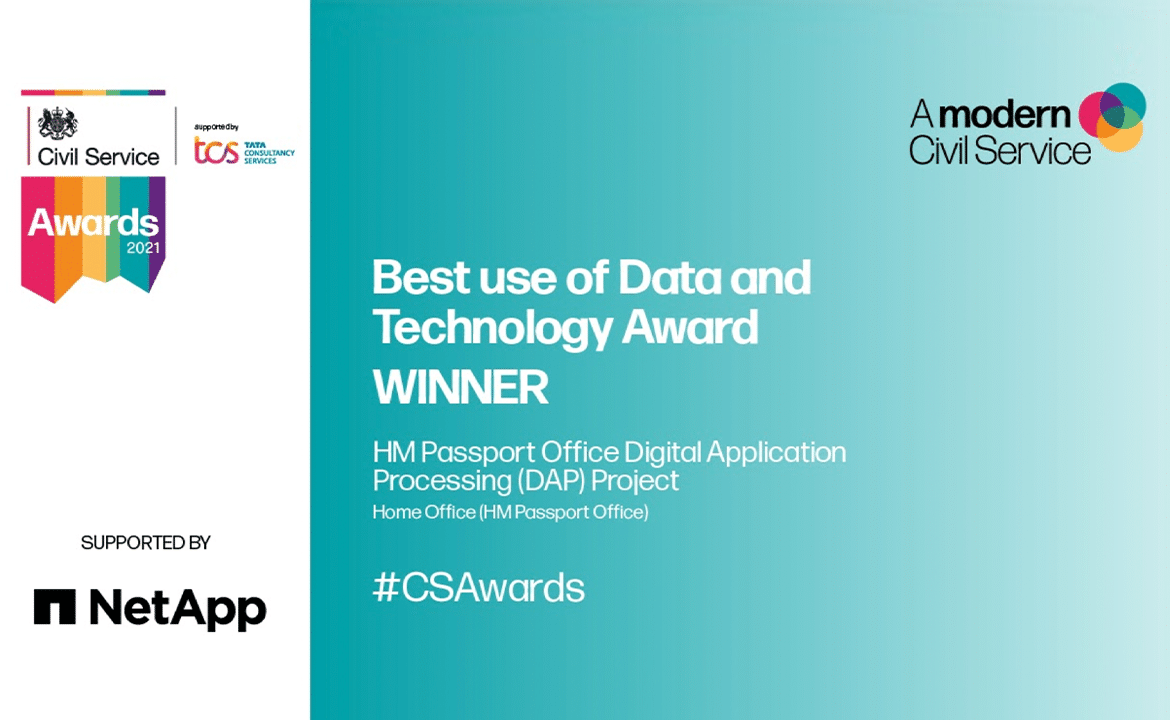
HMPO’s award-winning platform (DAP won Public Sector Project of the year and Development team of the year at the 2024 UK IT Industry award; HMPO was runner up in the Engineer of the Year category) now sees over 7 million passports delivered into the hands of its customers every year. Removing the need for frustrating manual processing has saved 50000 working days for this government department, with users reporting increased job satisfaction:
“My favourite thing about DAP is that there is no cherry picking and you have no idea from one application to the next what sort of application you’ll get.”
Customers, too, have been vocal with their praise for HMPO’s digital service:
“My wife and I have had passports for nearly 70 years and can comment on the new system with a wealth of experience behind us. I have NEVER, repeat NEVER, had such swift and efficient service with a passport ever, and the system is virtually idiot proof. If an 86-year-old can cope, that says a lot.”
The success of the engagement was called out by The Times newspaper in July 2023, which wrote: “Efficient digitisation has been HMPO’s path to redemption. The operation to digitise passports, set up a decade ago, has become a world leader, with the idea exported to countries such as America, Germany and Canada.”
The team is now looking to the future, including exploring the potential of AI to improve guidance for examiners and adjusting structures to minimise ongoing overheads.
Are you interested in this project? Or do you have one just like it? Get in touch. We’d love to tell you more about it.