Vendors are promising the world enormous productivity gains from the implementation of AI. Upwards of 50% in some cases. Yet Gartner’s own research puts the real number closer to 16%. This mismatch was the core theme running through almost every session at this year’s Gartner IT Symposium/Xpo on the Gold Coast.
AI autonomy vs automation
Gartner’s keynote, Shaping Momentum: Compounding Value and Risk for the Next Success Horizon, framed that same tension as momentum versus drag. Build the flywheel, then add the good drag that keeps it stable. Underneath that framing is a bigger shift. AI is about autonomy, not automation. Automation is a task you supervise by exception. Autonomy is a decision you’re accountable for by default, and the accountability doesn’t move with the work.
That might sound like a delegation problem, but it’s actually a governance one. Boards and executives already know that delegating authority never transfers responsibility for the outcome. You can delegate the outcome to AI. You can’t abdicate responsibility for it.
What’s different is the posture. Technology has always been designed around rules and control. However, AI runs on guardrails and an accepted level of risk instead. Which means the real constraint isn’t the model but how much risk the organisation is actually prepared to own.
AI readiness vs AI rhetoric
Alongside the informative keynotes and booth demonstrations, one of the most valuable parts of events like this is the opportunity for two leaders who’ve actually solved the same problem to compare notes in between sessions.
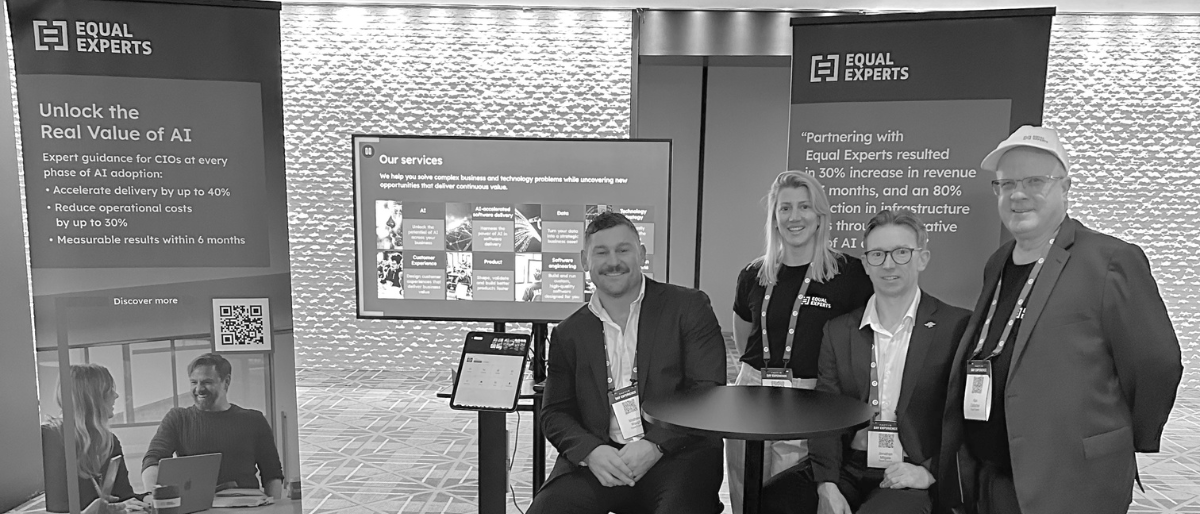
That exact dynamic is why we attend, and why Equal Experts will be exhibiting next year. Our approach and core values are built on partnering with client teams to solve complex delivery challenges in production, then openly sharing those hard-won learnings back with the broader tech sector. It means fostering genuine peer-to-peer knowledge sharing, helping leaders skip the vendor pitch and focus on execution with value creation.
Across those conversations and the entire event, the gap between AI rhetoric and AI readiness stood out. During the keynote, Gartner shared insights from its 2026 Hype Cycle for Agentic AI report, showing that 65% of organisations expect to deploy agentic AI within the next 12 months. But only 27% have governance in place for it today.
An interesting addition is that one third of CIOs surveyed are actively looking into AI insurance and 1% of CIOs already carry some form of protection against intellectual property infringement, copyright lawsuits, model hallucinations/errors, and data privacy violations. Gartner’s own Senior Director Analyst in the Gartner Legal & Compliance Practice suggests legal counsel should be “evaluating a new wave of ‘affirmative AI insurance’ offerings that provide targeted coverage for risks.”
Building trust in agentic systems within regulated environments
Trust in an agentic system isn’t something you sign off on once, and Gartner compared it to a self-driving car re-evaluating trust at every lane change. In the Banking: Top Strategic Technology Trends session, zero-trust architecture, least-privilege access for every agent, and full audit trails were drivers for moving from best practice to baseline for anyone giving an agent access to real customer data.
This aligns with what we’re seeing across our own client base too, especially organisations in a regulated environment, such as superannuation or healthcare. The question has shifted from whether to use agents to how an organisation ensures the ones deployed can be trusted, and can keep evolving as the business does. The actual constraints are rarely the model itself. It’s data, not enough of it structured or curated well enough to act on. And it’s governance, still built on old-world models of control rather than the guardrails and accepted risk this actually requires.
Gartner’s predictions for the future
Gartner also shared what it believes the future holds in a Signature Series session Top Strategic Predictions for 2027 and Beyond. By 2030, Gartner believes three in four technology solutions are expected to be built outside IT teams altogether, and it’s already close to half that today. Yet, only 11% of CIOs say IT is accountable for what gets built outside it.
Gartner’s other predictions for the next few years make that accountability gap look worse, not better. By 2029, they expect 80% of new applications to be intentionally disposable, built to last under a year and then thrown away rather than maintained. By 2030, agents are expected to be cheap and plentiful enough that public-facing services face genuine cost exhaustion attacks: not the traditional denial of service aimed at access, but one aimed squarely at draining an organisation’s token spend instead.
Both point at the same problem from different angles. When the thing you built barely exists long enough to need an owner, and when attacking a system means running up someone else’s AI bill rather than breaking in, the old idea of a single team accountable for one stable piece of technology stops holding up. Token monitoring and rate limits are turning into basic infrastructure, not a compliance afterthought.
What ties all of this together isn’t a framework or a piece of research. It’s a question almost every session kept circling back to without quite naming it. How much risk is this organisation actually willing to own, and who specifically owns it? Not a policy document naming a committee, an actual person or team prepared to be accountable when something goes wrong. Everything else we saw at Gartner – the guardrails, the governance structures, the AI insurance almost nobody has yet – is scaffolding around that one decision.
That’s a harder problem to solve than closing the gap between a sales number and the real-world benefits. But it’s the one that actually decides which of those two numbers an organisation ends up living with.
Speak to Equal Experts at Gartner Barcelona
Equal Experts will also be at the Gartner IT Symposium/Xpo in Barcelona this November – sponsoring, speaking, and bringing senior practitioners who’ve spent the last two years building AI-native delivery inside financial services, government, retail and enterprise. A highlight this year is our customer speaker, Adam Linford, Director of Technology at AXA UK, who will join us for our theatre session entitled Moving From AI Coding Tools to Measurable Value. Find out more about Equal Experts at Gartner IT Symposium/Xpo 2026 in Barcelona.
About the author
Jonathan Milgate is a Principal Technology Strategist at Equal Experts with over 15 years of experience scaling digital products and engineering teams. As a former CTO of an ASX-listed marketplace, he led a business from early-stage startup through IPO and international expansion across six markets. He works with technology leaders to connect what gets built to real business outcomes. Connect with Jonathan on LinkedIn.