At Equal Experts, we work with organisations to improve time to value and reduce the total cost of ownership of their products and services. A persistent barrier we see is the cost of software maintenance. Essential but non-differentiating work like vulnerability remediation, defect fixes and platform upgrades mitigates delivery risk and operational exposure. But the more effort teams spend there, the less capacity they have to deliver new value.
When senior technology leaders ask us “can AI speed up maintenance work?”, our answer is yes, but only up to a point. AI can speed up maintenance, but only within the limits of your delivery process.
AI coding assistants like Claude Code can dramatically accelerate coding speed, but if assurance activities like pre-production testing and change approvals are slower than coding, lead time improvements will be limited. Realising the potential of AI requires user-centric automated workflows, and downstream process changes.
Optimise maintenance effort
A CTO at a financial services organisation recently asked us if AI could speed up patching vulnerabilities across 40 teams. A newly introduced security scanner had identified thousands of vulnerabilities in third party software libraries, and 50+ new vulnerabilities were appearing each month. It’s a familiar pattern, and AI alone isn’t enough to fix it.
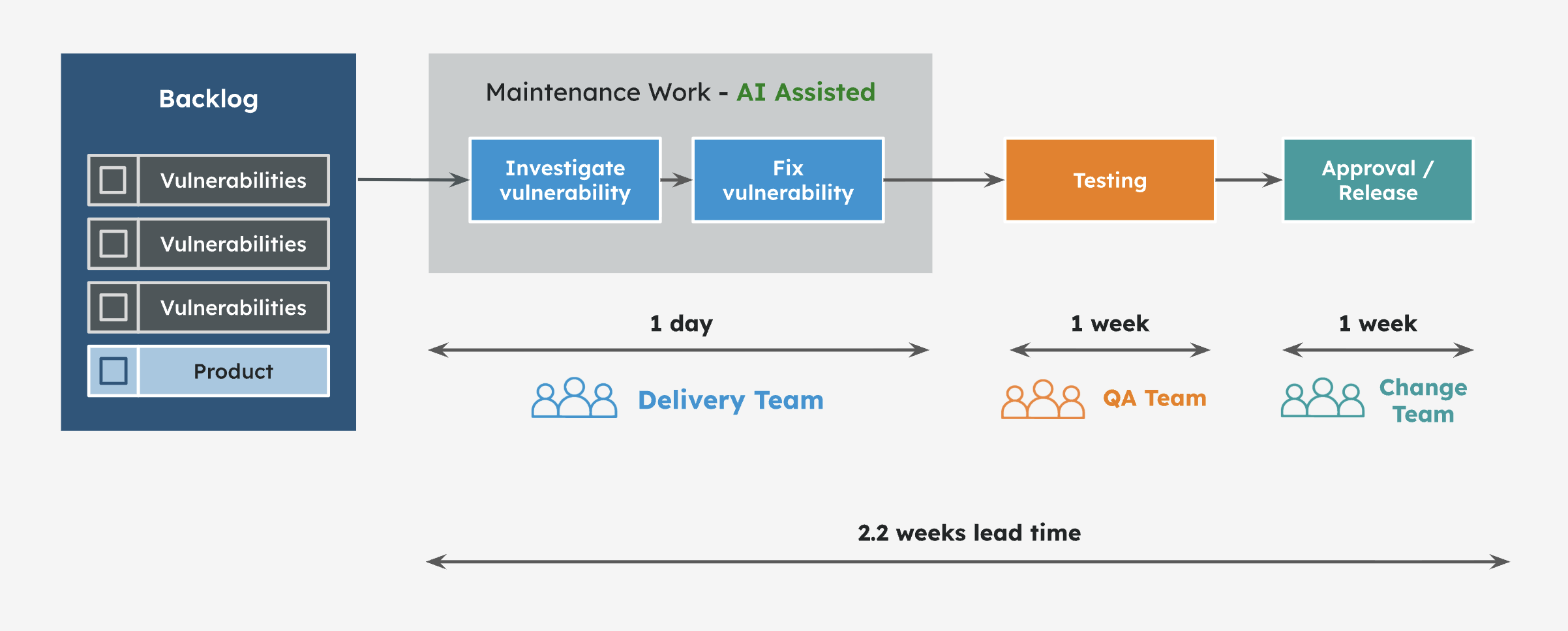
Here’s a composite example. A team of four engineers takes two weeks to find and fix vulnerabilities in their microservices. There’s a week of regression testing by a central testing team, and another week for change approval with a release window. That means it’s an end-to-end lead time of 4 weeks for remediation.
In many organisations, we’ve seen AI coding assistants consistently reduce the coding effort for maintenance work. Time-consuming, repetitive tasks like triaging findings, understanding unfamiliar code, and making repetitive changes can be completed in hours, not days or weeks.
However, in our composite team, if an AI coding assistant reduced the time for code fixes from 2 weeks to 1 day, the end-to-end lead time would still exceed 2 weeks. That’s because the regression testing and change approval phases take up more time.
Automate workflows
In most enterprises, assurance activities like testing remain manual or semi-automated. They’re expensive to run, slow to change, and intimidating to automate. What’s changing now is that AI is lowering knowledge barriers and simplifying how these workflows can be automated.
Delivery teams building their own automated unit and functional tests can significantly reduce the load on a central testing team and speed up delivery. Historically, this was a significant investment that required deep systems knowledge. AI assistants can now help engineers to rapidly understand behaviours, generate high quality tests, and shift some scenarios into observability tooling.
In our composite team, using AI to introduce automated tests could reduce the build and test cycle to a day, resulting in an end-to-end lead time of just over one week. Their test teams are no longer burdened with checking every small piece of maintenance work and can instead focus on differentiating product features.
Improving downstream processes
In many organisations, separation of responsibilities means queue times dominate delivery. Using AI assistants upstream can apply gentle pressure to rethink these processes and drive faster value cycles.
Maintenance work change requests can be streamlined as ITIL standard changes by using automated test evidence and AI-generated impact summaries. These changes free up change managers to concentrate on larger, functional changes and multi-system releases which carry significantly higher business risk.
In the composite team, fully automated CI/CD pipelines, in-team testing, and self-service deployments could dramatically shorten end-to-end lead times for maintenance work. End-to-end remediation would be in hours, creating more capacity for delivery teams to focus on value-adding work that improves business outcomes.
Conclusion
AI can be a powerful catalyst for making maintenance work cheaper and faster, but it’s not enough on its own. AI can speed up maintenance, but only within the limits of your delivery process.
Automate downstream assurance and build a fast-track release process for regular, low-risk maintenance work if you want to use AI to free up your engineers, testers and change managers to spend their time delivering reliable, differentiating products.
About the author
A specialist in security, platforms and modernisation, Chris has spent over a decade helping teams in finance, retail and government build delivery-focussed, scalable and secure software systems.
Having worked in product delivery, security and advisory roles, Chris specialises in building large-scale technical capabilities and introducing DevSecOps practices to help teams deliver securely at scale.
You may also like
Blog
Could MLOps be the key to accelerating your next AI project?
Blog
Adventures in how to use ChatGPT – can it answer questions about my business?
Blog
Adventures in fine tuning ChatGPT
Get in touch
Solving a complex business problem? You need experts by your side.
All business models have their pros and cons. But, when you consider the type of problems we help our clients to solve at Equal Experts, it’s worth thinking about the level of experience and the best consultancy approach to solve them.
If you’d like to find out more about working with us – get in touch. We’d love to hear from you.