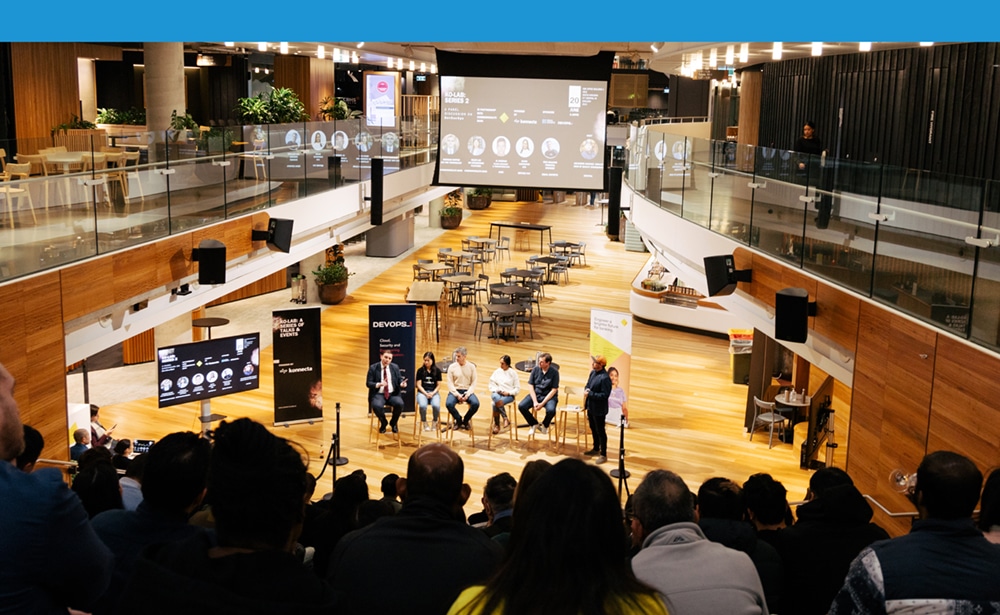
AI is transforming software engineering, but is it also reshaping the role of software engineers? That was the focus of a lively discussion at the latest Konnecta Ko-Lab Series 3 event in Sydney, which I had the pleasure of moderating.
The panel featured experts from across software engineering and AI including:
- Blair Hudson, Chief Engineer, Commonwealth Bank
- Dr. Shujia Zhang, CTO and co-founder of Reejig
- Sachin Abeywardana, Senior ML Engineer, Canva
- Livia Lam, Chief Product Owner, Gen AI Platforms, Commonwealth Bank
What became clear during the discussion is that AI is reshaping what we do and how we do it within technology.
Focusing on responsible AI to build trust
One word kept coming up throughout the event: trust. In particular, how can organisations adopting AI demonstrate that they are doing so responsibly and effectively?
The pace of change that we’ve seen with AI is unlike anything we’ve experienced in the past. With new tools and use cases emerging on a daily basis, it can feel impossible to keep on top of the AI landscape. Add to that the many stories of AI going rogue or hallucinating information, and it’s easy to see why there is still a lot of fear around AI. It’s the fear of the unknown.
To build trust, organisations need to focus on being transparent about how they’re using AI responsibly and the guardrails they’ve put in place, such as data governance or human-in-the-loop processes. For some businesses, in particular those with a limited appetite for risk, AI trust might be built slowly by demonstrating impact in small-scale, internal-only pilots, where the blast radius of any AI mistake is contained.
Equally important for building trust is improving AI literacy among teams across the whole organisation and at all levels, including the board and executive level. AI is uniquely different from other past technology shifts in its accessibility. Anyone can open ChatGPT or Copilot and start experimenting, and so the opportunities, as well as the risks, stretch beyond the tech teams. Organisations need to enable wider access to training and support, creating resources and best practices around AI so that it is used responsibly by all.
Reshaping the role of developers
With the increase in AI tools and the ability to generate code in a matter of minutes, there’s an understandable fear that AI could replace the roles that junior developers play within technology teams. However, the opposite could actually be true. AI has the potential to enhance capabilities and accelerate learning for junior team members.
Junior developers still rely on guidance from senior team members to guide them in what good looks like. Whether it’s writing code, accounting for edge cases or developing a testing strategy, senior members of the team play a vital role in maintaining quality in a team.
In an AI-enabled team, AI can act as an additional assistant, helping juniors move faster and tackle more complex tasks while senior developers dictate guardrails and ensure standards with AI-enabled outputs. As junior developers grow in skills and confidence, they will eventually become the next generation of senior developers, helping to sustain a continuous pipeline of AI-capable talent into the future. In this way, AI can help accelerate growth, rather than diminish it.
AI within the software development lifecycle
The panel also discussed how AI can be integrated within the software development lifecycle, a focus area for Equal Experts and something we’ve been supporting clients across Australia to explore.
Our phased approach to AI-accelerated software delivery helps organisations adopt AI responsibly while driving tangible business value:
- Augmented expertise: We focus on empowering individuals, including developers, product managers and testers, with the right AI tools focused on the right use cases for use in their day-to-day roles – boosting productivity while maintaining engineering discipline.
- Accelerated initiatives: Rapid experimentation through a real-world “AI exemplar” project to demonstrate value, refine the approach, and codify learnings into a tailored playbook for future AI initiatives.
- Ongoing transformation: Scale AI-enabled delivery across teams in the organisation with the right structures, governance, and strategy to support long-term, sustainable change.
Thanks to the panel for their insights and for everyone who attended and helped raise funds for Feel the Magic, a charity helping kids face, feel and heal from grief while building a community for families to belong.
If you’re exploring AI adoption in your organisation, connect with me and the Equal Experts team in Australia to harness AI safely and effectively.
About the author
Andy Canning is the Chief Technology Officer and Managing Director for Equal Experts APAC. With a technology career that spans the globe, Andy has been at the forefront of innovation for more than 30 years and is on a mission to revolutionise the business landscape through the transformative power of AI. Connect with Andy on LinkedIn